You publish your eighth video. You check YouTube analytics. 42 views — and worse, zero leads, zero customers, zero clients. If you're trying to sell something online, like high-ticket coaching or consulting, posting more videos and hoping to go viral isn't a strategy. It takes four components working together to turn YouTube into a client-getting machine, and posting videos is just one of them.
Here's the four-step system for how to get clients from YouTube without praying for a viral hit or turning yourself into a full-time content creator.
Why Posting More YouTube Videos Won't Get You Clients
Most people post a video, drop a link to their website or offer in the description, and hope someone watching buys. The problem: that path only works on your hot market.
Every audience breaks into three temperatures:
- Hot — people who know you, like you, and are almost ready to buy.
- Warm — people who know you and roughly what you sell, but aren't ready yet.
- Cold — people who don't know you exist, or just found you. They have the problem you solve, but they haven't warmed up to you.
Linking straight from a YouTube video to your offer only targets that hot 2%. Without a system to warm up the other 98%, you're ignoring the majority of your traffic.
The Problem With Selling Directly on Social Media
The biggest mistake early on is trying to hard-sell on social media and YouTube. People don't respond to it — and the algorithm won't push a post that reads as too salesy.
"Social media isn't a place where you want to sell. Everybody would avoid you, and the algorithm will not push your post because you're trying to be too salesy."
Think of social media as a party. You don't walk in and start pitching your stuff — everyone avoids the person doing that. Instead, you show up, you're a cool dude, people like you, and eventually someone asks, "So what do you do for a living?" That's when you tell them, and that's when you can say, "By the way, I've got this free thing — want it?"
The goal at the party isn't to close a sale. It's to meet people and move them into your private environment — an email list or a private community, where selling is actually welcome. If you want a full walkthrough of building that environment around your content, here's how I help founders do it.
How to Get Clients From YouTube: The 4-Step System
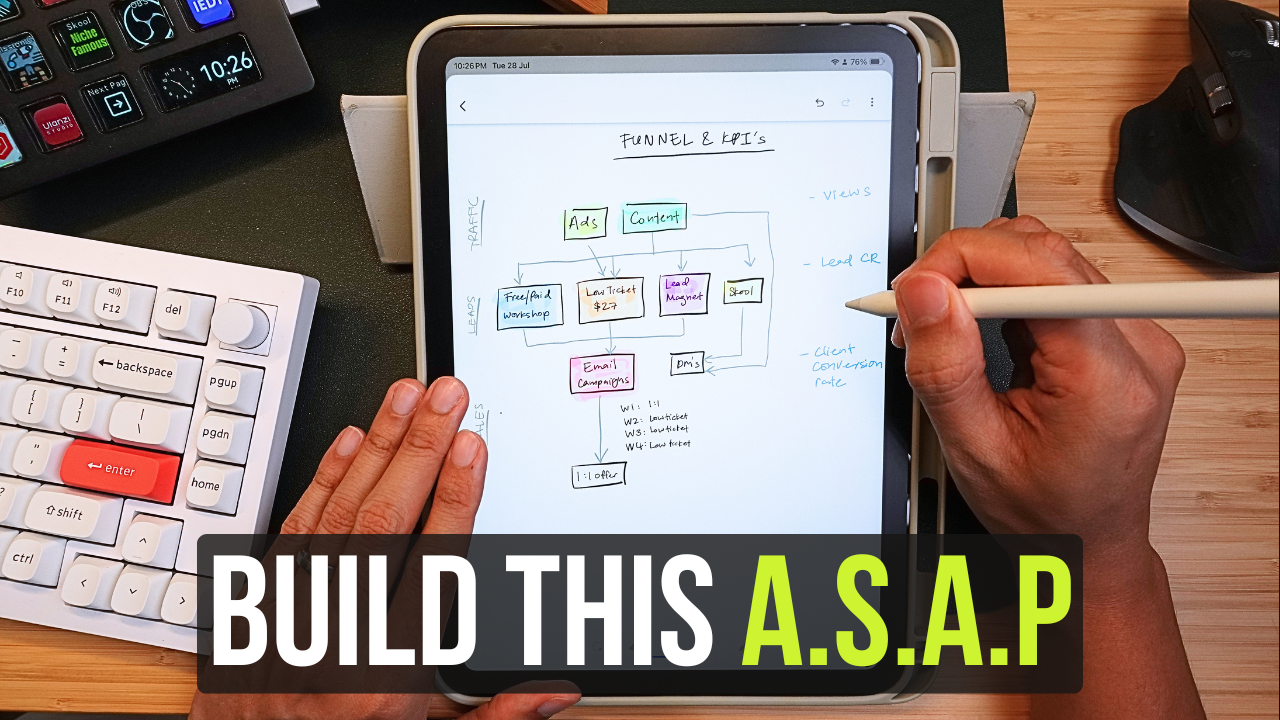
This is the funnel: traffic → a low-risk bridge offer → your email list → email campaigns that sell. Skipping straight from traffic to your high-ticket offer is why most creators post for months and get zero clients.
Step 1
Traffic
This is your YouTube video. Its only job is to earn attention and trust — not to close a sale.
Step 2
The Bridge Offer
Since most viewers aren't ready to buy your main offer, you need an easier "yes" first. Four options work here:
- A workshop — an invite to a live or recorded session.
- A low-ticket product under $50 — a PDF, a short video course, anything people buy on impulse.
- A free lead magnet — a template or low-risk resource people trade their email for.
- A free community — platforms like Skool are popular right now for this.
Whichever one they choose, all four roads lead to the same place: your email list.
Step 3
Build Your Email List
This is the whole point of the system. Your email list is the private environment you own, where selling is expected and welcome — unlike social media.
"The whole point of you doing everything is trying to get more people into your email list, because that is the environment where you can sell."
Step 4
Run Email Campaigns
Once someone's on your list, your offer doesn't sell itself. You need a rotation. A simple four-week structure:
| Week | What you promote |
|---|---|
| Week 1 | Your main (high-ticket) offer |
| Week 2 | A low-ticket offer |
| Week 3 | Another low-ticket offer |
| Week 4 | Free value, no pitch |
Rotating the offer matters — if you promote your main offer nonstop, there's no open-and-close cycle, and no urgency to buy.
Why This Beats "Just Go Viral"
Most YouTube advice for creators boils down to "try to go viral, and something good will happen." That's not how it works if you're selling a high-ticket service. Virality gets you views. It doesn't get you an email list, and it doesn't get you a sales system.
The three things you actually need to do: create traffic, get people into your list, and run marketing campaigns to sell inside that list. Posting content is one piece — not the whole system.
Which Stage Are You Missing?
Walk your own business through the four steps: traffic, bridge offer, email list, email campaigns. Most people already have step one. Very few have all four installed. If you want help building the parts of this you're missing, start here.
How do you actually get clients from YouTube?
You need four connected pieces: YouTube videos for traffic, a low-risk bridge offer (workshop, low-ticket product, lead magnet, or free community), an email list to move people into, and rotating email campaigns that sell your offer inside that list.
Why doesn't linking my offer in a YouTube video work?
Because it only reaches your "hot" audience — roughly 2% of viewers who already know and trust you enough to buy. The other 98% are warm or cold and need to be nurtured first, which a direct link can't do.
What's a good low-ticket offer to bridge people toward a high-ticket program?
Anything under $50 that solves a small, specific problem — a short video course, a template, or a digital product someone would buy on impulse without needing to talk to you first.
How often should I email my list to sell my offer?
A simple four-week rotation works well: promote your main offer in week one, a low-ticket offer in weeks two and three, and send pure free value in week four with no pitch at all.
Do I need to go viral to get clients from YouTube?
No. Virality drives views, not a sales system. Founders selling high-ticket coaching or consulting get more consistent results from a small, consistent audience moved through a proper funnel than from chasing viral hits.
Your First Video Doesn't Have to Be Cringe (Done in 30 Minutes)
Grab the free Niche-Famous Starter Kit and get the exact steps to film a video you're not embarrassed to post — today.
Get the free starter kit →