You've been posting YouTube videos for your business. Maybe a few views, maybe some subscribers — but still no leads. Every YouTube guru gives you the same advice: post more, be consistent, chase the next trend. You do it. Nothing changes.
The problem isn't your content. It's that posting is not a system. And without a system, YouTube is just a content treadmill that never pays you back. What actually works is mapping out your entire client-getting strategy — offer and lead generation — on a single page, then using Claude AI to handle the parts that would otherwise require a team. This video walks through the full system, step by step.
The Two Things That Have to Work Together
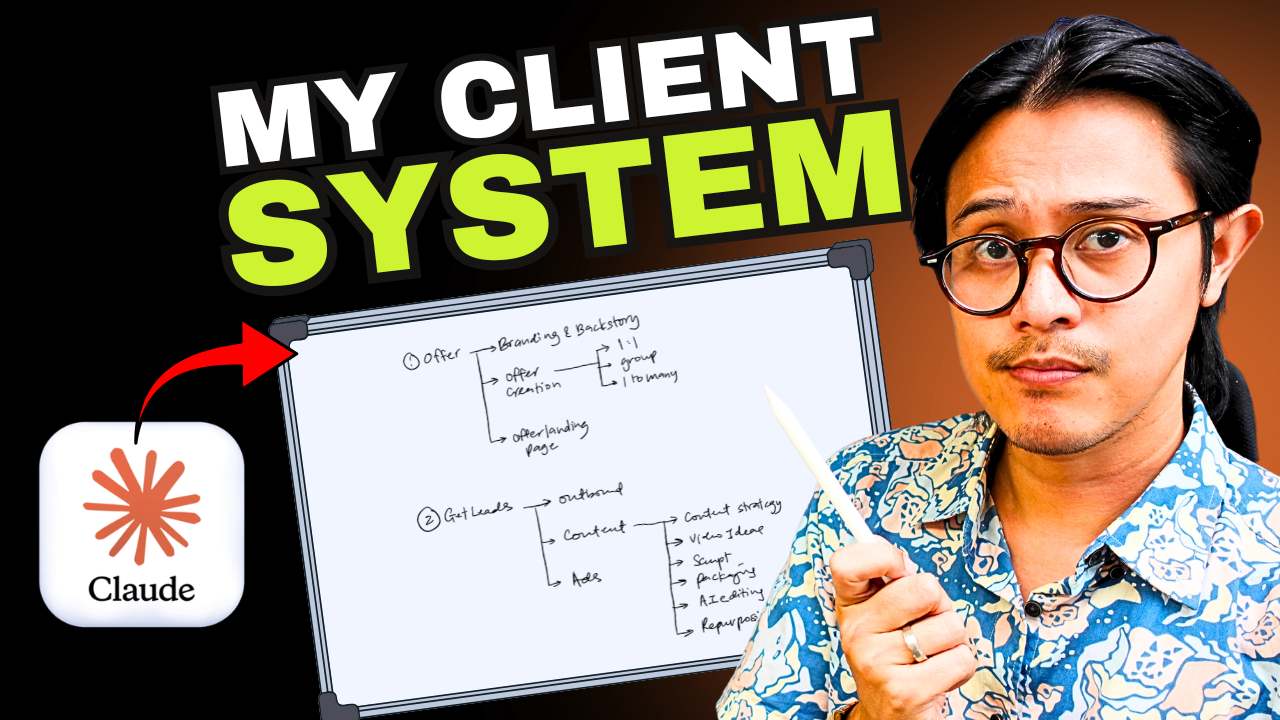
The FrameworkThere are exactly two things you need to get clients from YouTube. Not ten. Two. And most business owners only have one of them — which is why the channel never converts.
1. An Offer
- Something specific you sell to solve a specific problem
- Backed by a backstory that makes you the right person to sell it
- Delivered in one of three formats: 1:1, group, or 1-to-many
- Explained on a single landing page
2. A Way to Get Leads
- Outbound — you find people, start conversations, pitch
- Content — YouTube videos that attract inbound leads over time
- Ads — paid traffic to your offer page
Most people start with content (YouTube) and skip the offer — which means views go nowhere. Or they build an offer but have no lead channel. The system only works when both sides run simultaneously. Claude AI handles the heavy lifting on both.
Part 1: Build an Offer Worth Selling
The OfferStep 1 — Extract your backstory (the part most people skip)
Your offer is probably a commodity. Someone else is almost certainly selling something similar, probably cheaper. The only thing that makes a prospect choose you over the cheaper alternative is your backstory — the reason you went from wherever you were to doing this specific thing. That story is what makes your ideal client feel seen and want to work with you.
The problem: most people can't extract their own story because they're too close to it. The patterns that make you unique are invisible to you. What works is sitting down with someone for about 60 minutes — someone who asks the right questions, hears you start telling a story, and says "that's a video idea." Then another story, another video idea. By the end of the session, the pattern emerges: the thing that makes you different that nobody else in your space is doing.
"Most of you would have a problem trying to extract your own story simply because you're too close to it. It's the same with me. I also couldn't extract my own stories — I had to get somebody else to ask me the questions and see the patterns."
This is where Claude AI comes in: not to replace the human conversation, but to analyse the transcript of it. After the session, feed the recording transcript to Claude and ask it to surface your unique selling point, find the patterns in your stories, and generate video ideas from them. Then you and Claude agree or disagree on what came up. The output is a positioning statement you actually believe and video ideas that only you could make.
Step 2 — Choose your delivery format
Once you know what you're selling and why you're the right person to sell it, choose how to deliver it. There are three formats, and they're not mutually exclusive — they're a value ladder.
- 1:1 (highest access, highest price) — the most direct access to you, full attention, most expensive tier.
- Group (1:10) — you work with around 10 people doing the same thing together; more scalable, lower price point than 1:1.
- 1-to-many (workshop or webinar) — online event, maximum reach, lowest price or free.
If you're starting out or testing a new offer, start with 1:1. It gives you the fastest feedback on whether people will actually pay for this, and it builds the case studies you need before you can sell a group programme.
Step 3 — Build a one-page landing page with Claude
You need one page that answers three questions: who is this for, why should they trust you, and what will this help them achieve? A year ago, building that manually took hours. Now Claude can design the full page — matching your brand colours, fonts, and tone — and generate the HTML code you paste directly into your website builder. No designer, no developer, no back-and-forth. The output looks like you because you fed it your positioning and brand brief first.
Part 2: Get Leads to Your Offer
The Lead EngineYou have three channels available. Here's how each one works — and where Claude fits in each.
Outbound — find the right people first, then talk to them
Outbound means you go to the prospects, rather than waiting for them to find you. The challenge is identifying who to contact without spending hours manually scrolling through social media. Claude solves this by scraping for you.
The approach: find a prominent person on LinkedIn whose audience overlaps with your ideal clients. Ask Claude to scrape everyone who engaged with their recent posts, then filter that list down to people matching your ideal client profile. Claude generates a spreadsheet — name, profile, status columns (call booked, in conversation, closed, ghosted, not a fit) — ready for you to work through.
"I'm not using AI to replace me. All I'm doing is using AI to scrape the leads so I can know who to talk to in the first place — without me having to do it manually."
Critically: Claude finds the leads, but you do the actual outreach. The moment a prospect realises they're talking to a bot, you lose the conversation and potentially your reputation. AI handles the research; you handle the relationship. If you're working with a new offer and haven't validated it yet, start here — with your warm network first, then expand to LinkedIn. This is the fastest way to find out if people actually want what you're selling.
Content (YouTube) — the highest ROI lead channel, if you do it right
Content takes more upfront effort than outbound, but it's the only lead channel that compounds. A video you publish today can book a client six months from now while you're doing something else. The reason most business owners quit is that doing it manually — strategy, ideation, scripting, packaging, editing, repurposing — is unsustainable alongside running an actual business.
The solution is a stack of Claude skills, each one handling a specific department:
| Department | What it does |
|---|---|
| Content strategy | Decides what kind of videos to make based on your niche, offer, and target audience — so every video serves a business purpose, not just a view count. |
| Video ideas | Generates ideas that have real search demand and connect to your offer. If a video can't attract the right viewers or lead to a client conversation, it doesn't make the list. |
| Scripting | Turns an idea into a structured outline or script. Before AI, this step alone took 2–3 days per video. Now it takes a fraction of that — and stays in your voice. |
| Packaging | Writes the title and brief the thumbnail concept. No matter how good the video, if nobody clicks, nothing happens. Packaging is what tells the algorithm who to show it to, and makes the right people click. |
| Repurposing | Takes the published YouTube video and turns it into LinkedIn posts, X threads, Facebook updates, and email campaigns. Long-form video becomes the content engine for every other channel — which means you're never scrambling for what to post today. |
Without AI, each of those departments is a hire. With Claude skills, it's a conversation. The human inputs are your stories, your voice, and your offer. Claude handles the production layer around them. If you want to see what this system looks like inside a community where other founders are building the same thing, see the options here.
Ads — the fallback, not the foundation
Paid ads are tempting because they feel measurable and avoid the effort of content. But ad costs rise every year, and they eat directly into your margin — especially for service businesses where the unit economics are already tight. Ads work best as an accelerant on top of an already-validated offer and a working organic channel. Starting with ads before you have either is an expensive way to find out your offer doesn't convert.
The Whole System, on One Page
The promise of this approach is that your entire client-getting operation — offer, positioning, lead generation, content pipeline, and repurposing — fits on a single sheet. Not a complex funnel map with 40 stages. One page you can look at and immediately know where you are, what's working, and what to do next.
That clarity is what AI makes possible. Not by replacing you — your story, your expertise, and your relationships are irreplaceable — but by handling every production and research task that would otherwise require a team or consume your entire week. It's just you and a set of AI agents running the system together.
Frequently Asked Questions
Do I need a big YouTube audience before this system works?
No. The system is designed to get your first inbound clients before you have a large following — the target is your first $1,000 client within 90 days of starting. The outbound track works immediately, and YouTube content begins building pipeline in parallel. You don't need 10,000 subscribers to book a discovery call; you need the right video in front of the right person at the right time.
Should I start with outbound or content first?
Outbound first, especially if your offer is new or unvalidated. Outbound gives you direct feedback from real prospects within days. Content is slower but compounds over time. The system runs both simultaneously — outbound funds you while content builds inbound momentum. Most successful founders use the first 30–60 days to validate through outbound, then double down on content once they have proof the offer converts.
Can Claude actually write my landing page?
Yes. Feed Claude your positioning statement, your offer details, your target audience description, and your brand colours and fonts. Ask it to generate a one-page landing page HTML file. Copy the code and paste it into your web builder. The output handles structure, copy, and basic design — it won't replace a designer for a premium brand, but for a working, professional offer page it's more than sufficient and takes minutes instead of hours.
What's the difference between using Claude for outreach versus AI outreach automation?
Claude is used to research and identify prospects — scraping LinkedIn engagement, filtering by ideal client profile, generating a lead list. The actual messages are written and sent by you. AI outreach automation sends messages on your behalf automatically, which prospects can detect and which damages trust. The distinction matters: AI for research, humans for conversation.
How long does it take to set this system up?
The core setup — positioning, offer, landing page, and first lead list — can be done in a focused day or two using Claude. The content system (skills for strategy, scripting, packaging, repurposing) takes a few more sessions to configure and test. Most founders in the community have the full system operational within two to four weeks, with the outbound track running from week one.
Ready to Build Your Own One-Page Client System?
Start with the Stories-to-Clients™ Starter Kit — the framework for turning your backstory into a YouTube system that books calls without you chasing anyone.
Get the free starter kit →